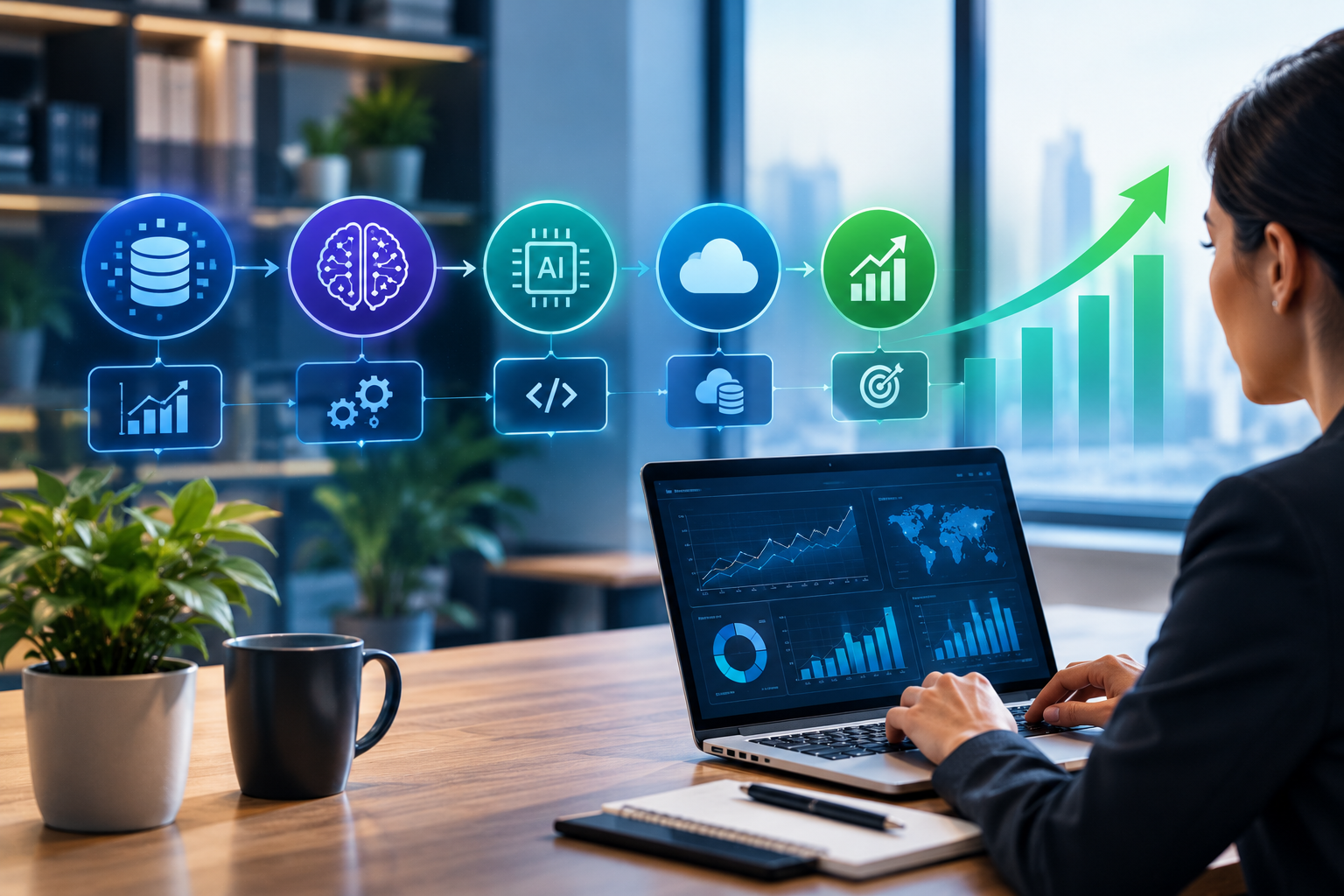


Most corporate debates around AI in the workplace still get stuck on a binary question: will software replace employees, or will it create new roles? That framing misses what actually drives business results. Real value rarely comes from removing people from processes; it emerges through intentional human-AI collaboration, where computational speed meets domain experience. As AI adoption in business accelerates, competitive organisations are building a hybrid workforce—pairing intelligent systems with human judgement to solve problems neither could handle alone.
Why Human-AI Collaboration Is Becoming a Strategic Priority
Organisations face mounting pressure to process larger datasets and make faster decisions without sacrificing operational quality. Relying exclusively on manual workflows creates bottlenecks, yet uncritically trusting automated outputs introduces costly errors, compliance risks, and generic results.
AI excels at pattern recognition, rapid information synthesis, and repetitive execution. However, human intelligence and AI serve fundamentally different functions. Employees provide institutional context, ethical accountability, interpersonal empathy, and critical thinking when edge cases arise. Research underscores a widening execution gap: in Deloitte’s 2026 Global Human Capital Trends survey of over 9,000 leaders, 66% agreed that intentionally designing human-machine interaction is vital to organisational success, yet only 6% believed their companies were making meaningful progress. Closing that gap requires treating AI augmentation as an operational design challenge rather than a simple software rollout.
Where Human Expertise and AI Work Best Together
Effective human and AI collaboration looks distinct across core business functions, depending on where speed matters most and where accountability must remain human.
- Data Analytics and Business Intelligence: Machine learning models can clean messy datasets, detect anomalies, and surface correlations in seconds. Data analysts then apply commercial context—distinguishing genuine market shifts from statistical noise—and translate those findings into executive action.
- Software Development and IT Operations: AI coding assistants accelerate boilerplate generation, unit testing, and documentation. Experienced engineers remain essential for system architecture, security validation, performance tuning, and resolving complex integration trade-offs.
- Customer Experience and Business Operations: Automated workflows and conversational tools resolve routine enquiries and route tickets efficiently. Human specialists step in for high-stakes negotiations, nuanced complaints, and long-term relationship management.
- Strategic Planning and Decision-Making: Analytical tools model financial scenarios and synthesise competitor movements across vast inputs. Senior leaders weigh those projections against organisational culture, risk appetite, and stakeholder trust before committing capital.
Building a Workforce Prepared for AI Transformation
Purchasing enterprise licences does not automatically produce AI-powered productivity. According to the World Economic Forum’s Future of Jobs Report 2025, employers expect 39% of workers’ core skills to change by 2030, making continuous upskilling central to workforce transformation.
To prepare teams for the future of work, leaders must take practical steps beyond tool procurement:
- Build practical AI literacy: Train employees to evaluate model limitations, spot hallucinations, and verify outputs within their specific domain workflows.
- Redesign processes around clear ownership: Map which steps belong to automation and where human sign-off is mandatory, ensuring accountability never blurs.
- Create safe spaces for experimentation: Microsoft’s 2026 Work Trend Index notes that while 65% of AI users fear falling behind if they do not adapt quickly, 45% feel safer sticking to existing routines than redesigning how they work. Rewarding thoughtful process improvements reduces resistance and encourages responsible adoption.
The Future Belongs to Better Human-AI Collaboration
Building a resilient hybrid workforce is ultimately about aligning human-centric AI with clear business goals. When organisations pair reliable data foundations with skilled people, human expertise and artificial intelligence reinforce one another, lifting both speed and decision quality.
At Jay Analytix, we help organisations bridge technology and talent through comprehensive data solutions, AI and machine learning development, performance engineering, and specialized IT staffing. Ready to strengthen your technical capabilities and modernize your workflows? Explore our solutions or contact our team to start the conversation.