

The most expensive hour in business is the one bought from a skilled professional and spent on data entry.
For decades, the narrative surrounding corporate technology promised massive, sweeping transformations – monolithic systems designed to rewrite how executives made strategic choices. Yet, if you audit where operational friction actually occurs, it is rarely in the high-level strategy meetings. It is found in the quiet accumulation of minor administrative frictions: the fifteen minutes spent manually moving data from an email into a CRM, the tedious process of cross-referencing paper invoices, or the endless email chains required just to approve a routine purchase order.
True operational efficiency is rarely born from a massive tech overhaul. Instead, the modern wave of digital transformation is turning away from complex decision-modeling to focus on something far more immediate: deploying AI for business automation to handle the repetitive tasks that quietly stall company growth.
Redefining AI for Business Automation
To understand AI automation, it helps to draw a line between the tools of the past and the capabilities of the present. Traditional business automation operated on strict, unforgiving logic: if X happens, do Y. The moment a vendor sent an invoice as a JPEG instead of a PDF, or a customer phrased an email inquiry using unconventional language, the traditional system broke, requiring human intervention.
Modern process automation infuses these workflows with a layer of adaptable intelligence. By blending standard software pipelines with AI capable of reading context, interpreting messy data, and understanding natural language, systems can now manage variability. It isn’t about replacing the human element; it is about building digital infrastructure capable of handling the routine work that humans find draining.
The Workflows Demanding Automation Today
When evaluating an organization for potential automation solutions, the rule of thumb is simple: if a task is predictable and high-volume, it should be automated. Forward-thinking operations are actively targeting several key areas:
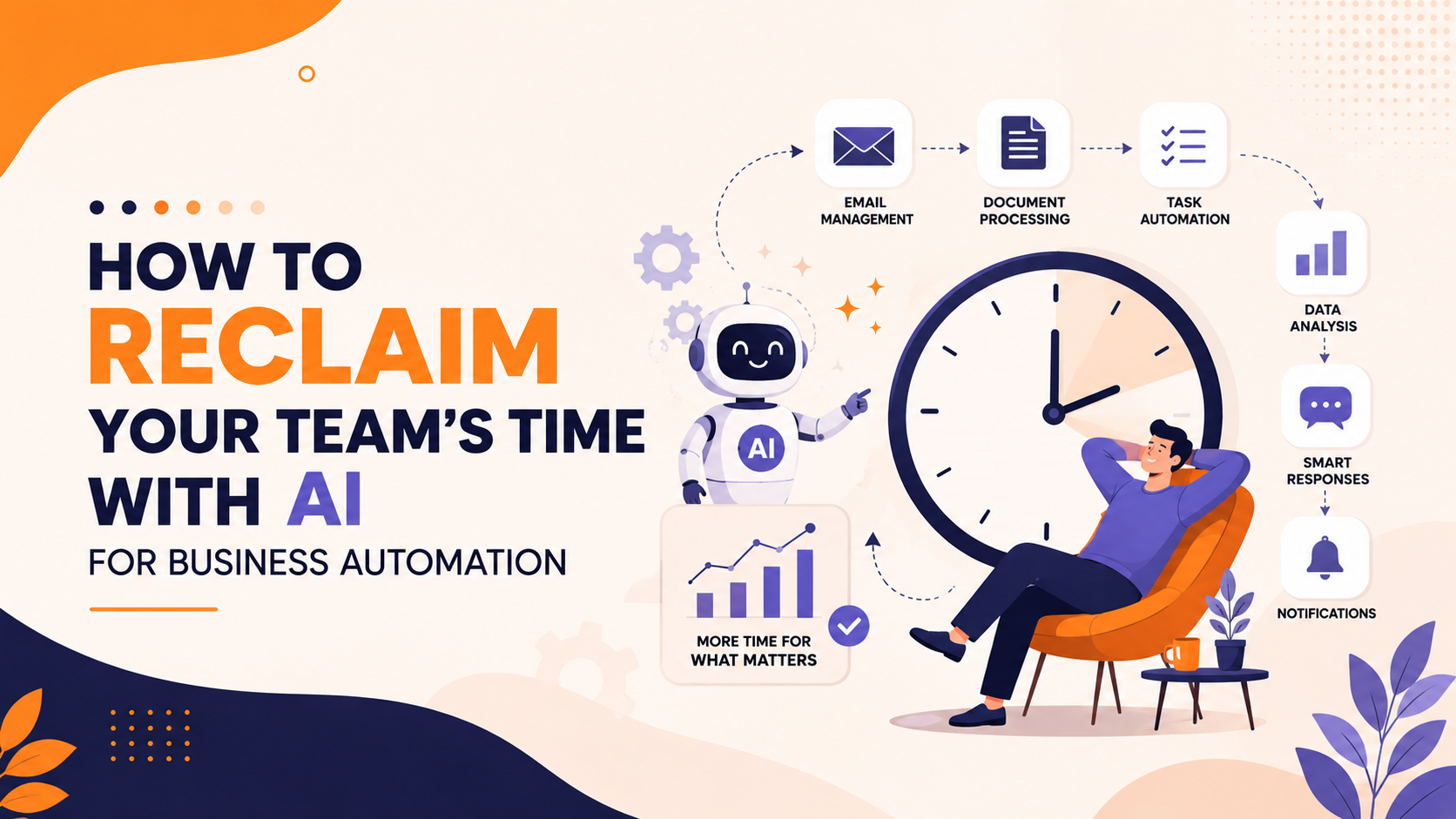
- Document Intake and Invoice Processing: Instead of manually extracting billing data, intelligent systems read incoming documents, validate the numbers against purchase orders, and queue them for payment.
- Smart Communication and Lead Routing: AI analyzes incoming client emails, categorizes the intent, drafts contextual replies, and hands off qualified opportunities to the right team member.
- Onboarding and Administrative Reporting: From triggering new-hire workflows to aggregating weekly operational summaries, background processes can manage data movement across disparate legacy systems without human friction.
Overcoming the Limits of Rigid Workflows
The reason older business process automation initiatives frequently underperformed is that business itself is inherently unpredictable. Workflows change, formats shift, and human communication is messy. Because AI can navigate this ambiguity, it dramatically lowers the failure rate of digital workflows. It brings a level of cognitive flexibility to workflow automation, ensuring that minor exceptions don’t bring entire back-office operations to a sudden halt.
The Quantifiable Value of Operational Efficiency
Shifting the burden of routine administration to intelligent systems isn’t just a matter of convenience. It is a measurable competitive advantage.
- Reclaiming Productive Hours: Research by McKinsey indicates that up to 30% of hours currently worked across the US economy could be automated by 2030, largely due to generative AI’s ability to absorb routine administrative work.
- Eradicating Data Friction: Inaccurate data entry cascades into larger operational issues. A Gartner analysis underscores that combining AI with task automation drastically reduces manual compliance and transcription errors.
- Sustainable Growth: Scalability shouldn’t always require a linear increase in payroll. A study by ServiceNow revealed that 71% of executives view automated operational workflows as a critical lever for managing expanding workloads without inflating headcount.
Designing a Pragmatic Automation Strategy
Succeeding with AI for business automation requires a tactical, phased approach rather than a grand corporate mandate. The most effective strategy begins by mapping current workflows to isolate the single most time-consuming administrative bottleneck. By securing a small, highly visible automation win, such as automating standard customer follow-ups or invoice routing, an organization builds the momentum and internal trust needed to scale efficiency across other departments.
Bridging the Operational Gap with Jay Analytix
Deploying these systems effectively requires more than just buying software; it demands a deep understanding of how workflows connect. Jay Analytix works alongside growing businesses to identify friction points, integrate platforms, and build tailored automation architecture. By focusing on practical, operational gains, Jay Analytix helps companies optimize their daily workflows and maximize employee productivity.
Conclusion
The organizations extracting the highest value from technology today aren’t the ones chasing the most complex, theoretical use cases. They are the businesses quietly removing the micro-bottlenecks that occur hundreds of times a day. True competitive advantage starts on the ground floor, by systematically replacing repetitive manual labor with seamless, intelligent workflows.